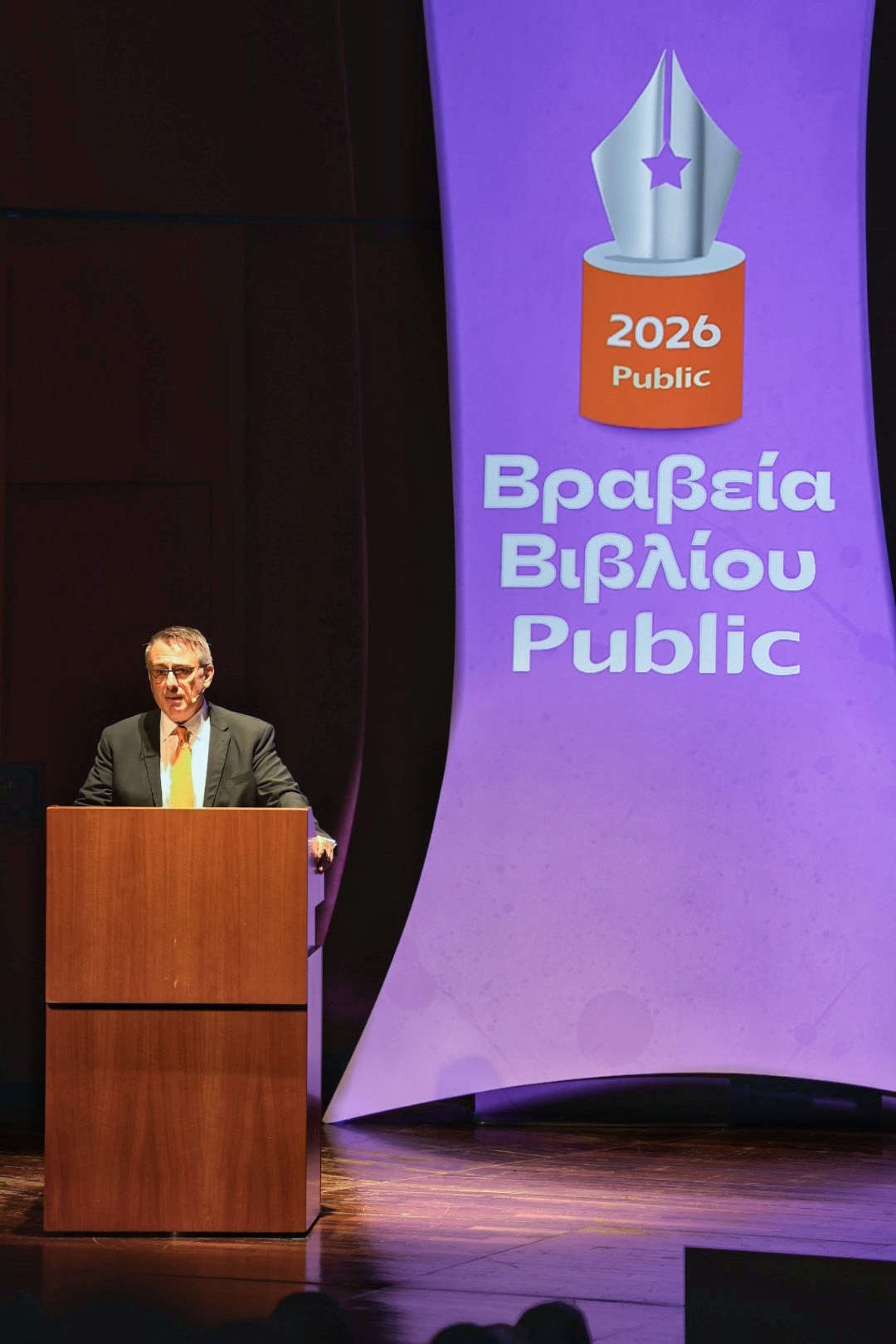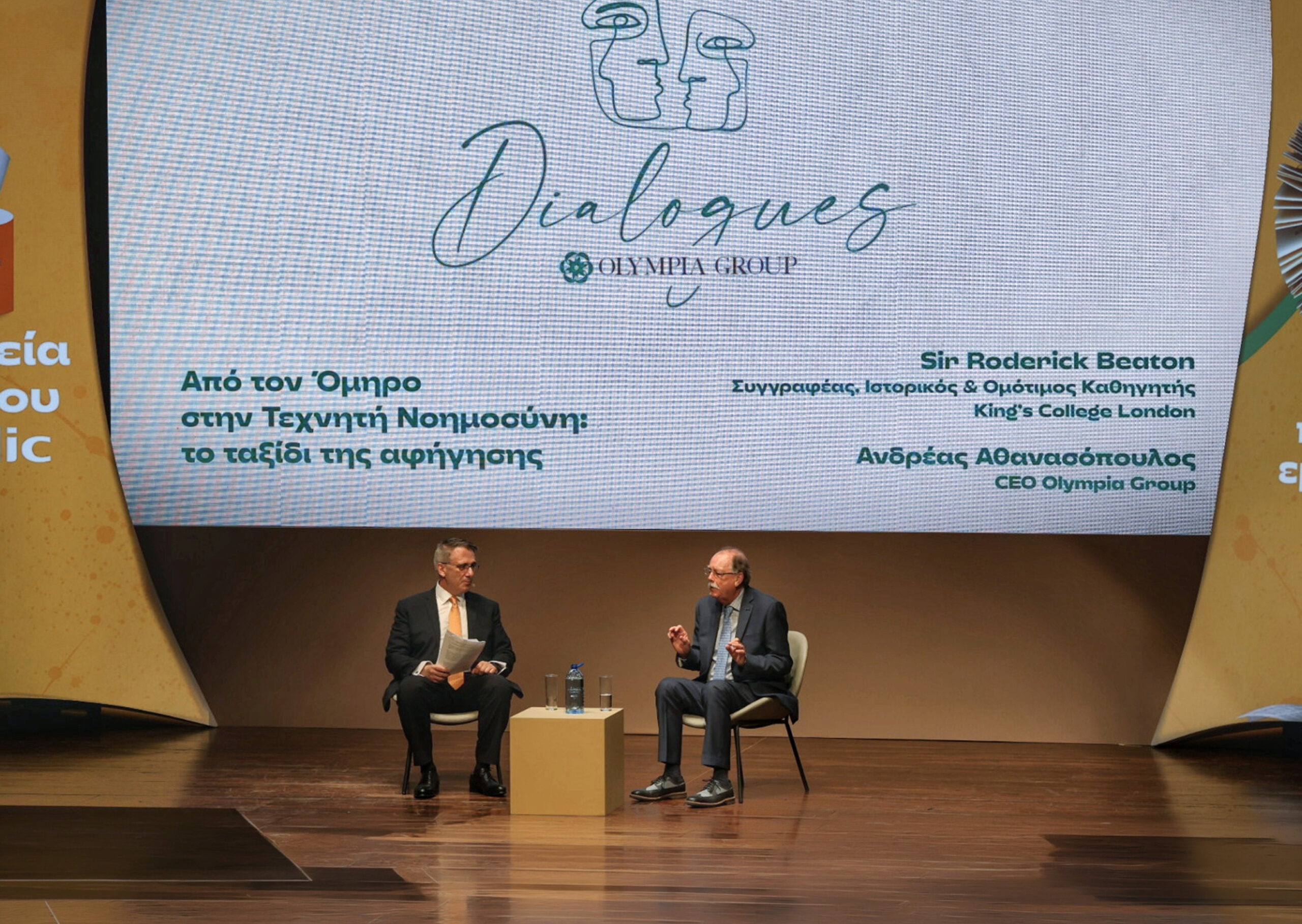
“The renewal of Europe.” With these words, Sir Roderick Beaton – one of the most distinguished international scholars of modern Greece – responded to one of the central questions posed by Olympia Group CEO Andreas Athanassopoulos during the Olympia Dialogues, titled “From Homer to Artificial Intelligence: The Journey of Storytelling”, held on the occasion of the Public Book Awards 2026 ceremony.
Mr. Athanassopoulos recalled that Greece’s 20th century was shaped by leaders who each offered their own vision for the country’s path: from Eleftherios Venizelos’s “Megali Idea” and Konstantinos Karamanlis’s “Europe,” to Georgios Papandreou’s “Democracy of the People” and Andreas Papandreou’s “Change.” He invited Mr. Beaton to answer what single word might describe Greece’s next historical chapter in an era of geopolitical upheaval, artificial intelligence, demographic challenges, and climate crisis.
The distinguished British academic’s answer concerned not only Greece but the future of the entire continent, as Europe today faces major challenges and is called upon to redefine its role in a changing world. “Europe is threatened from the East, but today it may also be threatened from the West. In this environment, we need to ask ourselves again: what is Europe? To ‘re-invent’ it, not only at the level of institutions, but as a community of people who share common values and historical references,” he noted.
In this context, he expressed his conviction that Greece can play a leading role, as Greek civilization is a cornerstone of European culture, with the values of equality before the law and the rule of law having been born in ancient Greece and continuing to influence modern Europe.
Mr. Beaton’s relationship with Greece began in his adolescence. As he recounted, a trip to the country at the age of 14, combined with his first lessons in Ancient Greek, shaped his academic and research career. “I was captivated by the idea that the very same language I heard spoken on the streets of Athens also existed in the verses of Homer. Everything that followed grew out of that magic,” he said, describing his work as a sustained effort to understand and interpret the continuity of Hellenism from Homer to modern Greece.
Sir Roderick Beaton is considered one of the most significant international figures in the field of Modern Greek studies. A British historian and author, he served for many years as a professor at King’s College London and dedicated his work to the study of modern Greece, its literature, and the formation of Greek identity. With books such as Greece: Biography of a Modern Nation, he made a decisive contribution to making modern Greek history more comprehensible and accessible to international audiences, establishing himself as one of the most important ambassadors of Hellenism in the global academic community.
The conversation between the British author and Mr. Athanassopoulos extended to the challenges posed by Artificial Intelligence and its parallels with previous technological revolutions, with both interlocutors acknowledging that similar fears had been expressed in the past, even about the invention of writing itself.
“Plato feared that writing would weaken human memory. Today we express similar fears about Artificial Intelligence. Yet neither writing then nor AI today is inherently good or bad. The outcome depends on how we use them,” said Mr. Beaton. He noted that humanity has consistently demonstrated throughout history its ability to adapt to major technological changes without losing the essential elements of human experience.
The conversation concluded with a reflection on the importance of books, reading, and critical thinking in an age of speed, algorithms, and artificial intelligence. Mr. Beaton acknowledged the advantages of smartphones and new technologies in communication and access to information, but emphasized that the book continues to offer a unique experience. “The book is also a physical object: it has presence, it has scent, it has texture; it demands time and attention. What we see on screens often flashes past our eyes. The book, by contrast, invites us to pause, to think, and to absorb. It can become a friend, unlike a smartphone, which can never become a friend in the same way. The book passes through the soul of the one who wrote it and through the soul of the one who reads it. That encounter cannot be replicated by any technology.”
For his part, Mr. Athanassopoulos underscored that the mission of Olympia Group, as envisioned by its founder Panos Germanos, is to create a positive impact, not only on the economies but also on the societies in which it operates.
“We believe you cannot build sustainable businesses in societies that are becoming culturally impoverished. You cannot find leaders if today’s youth grows up without the habit of deep thinking, critical perspective, and the ability to synthesize. These are not things you learn from social media. You learn them from books, from History, from dialogues, whether with the protagonists themselves or with other readers. And it is this conviction that gave birth to the Olympia Dialogues,” he said.